
For many overseas buyers, Japan still carries the image of being a “cheap property market” because of the weak yen and the country’s long period of low inflation. However, the reality in 2026 is far more complex. Japan has some of the cheapest real estate in the developed world, while also having some of the most expensive urban housing markets in Asia.
In some rural areas, buyers can still find detached homes for under ¥10 million, while newly built luxury condominiums in central Tokyo often exceed ¥100 million. Premium units in Minato and Chiyoda can reach several hundred million yen because of limited supply and strong demand.
The Japanese real estate market today is defined by a sharp contrast between urban concentration and regional decline. While many rural prefectures face depopulation and excess housing supply, central Tokyo continues experiencing strong demand, limited land availability, and aggressive redevelopment activity.
Average House Prices in Japan (2026)
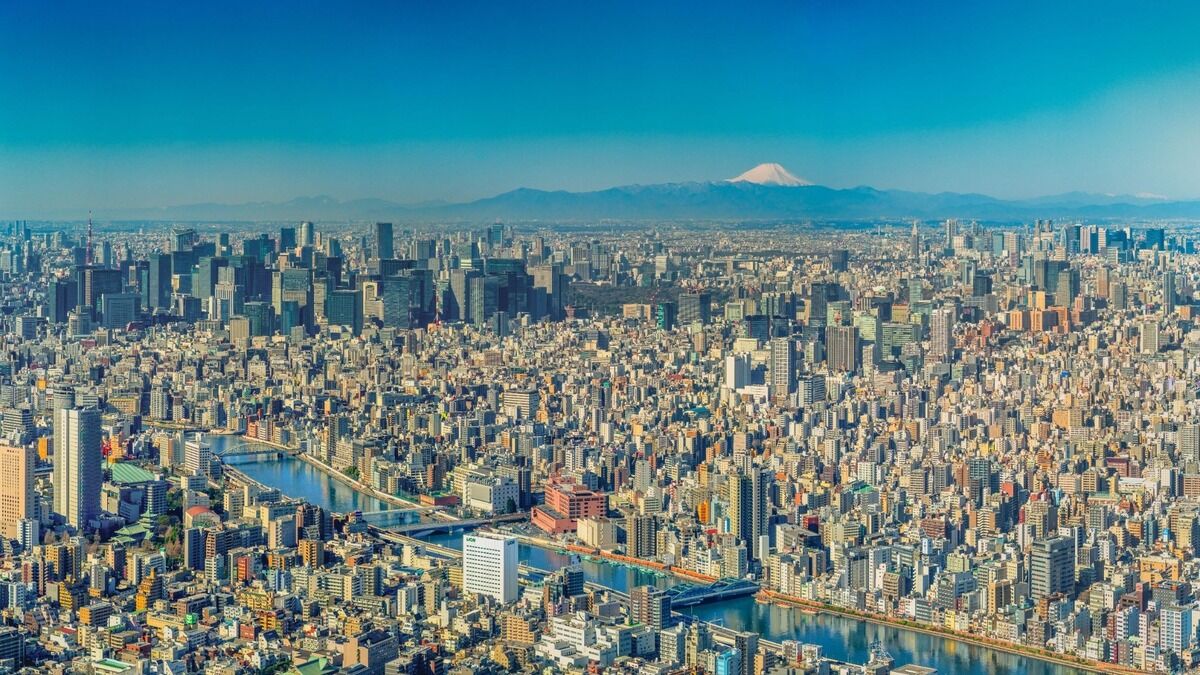
As of 2026, average residential property prices in Japan vary dramatically depending on location, property type, and access to transportation infrastructure. Major metropolitan areas continue to outperform regional markets due to stronger population inflows and investment demand.
|
Area |
Average Condo Price |
Average Detached House Price |
|
Greater Tokyo (首都圏) |
¥90.55M |
¥50.38M |
|
Central Tokyo 23 Wards |
¥100M–¥200M+ |
¥80M–¥150M+ |
|
Kansai / Osaka Region (近畿圏) |
¥66.66M |
¥41M–¥45M |
|
Chubu / Nagoya Region (中部圏) |
¥44.53M |
¥35M–¥40M |
|
Fukuoka |
¥35M–¥55M |
¥30M–¥50M |
|
Sapporo |
¥25M–¥40M |
¥25M–¥40M |
source:
- Condo market data: https://www.sumai1.com/useful/plus/market/plus_0329.html
- Detached house market data: https://www.sumai1.com/useful/plus/market/plus_0330.html
- Additional Tokyo market reference: https://www.kantei.ne.jp/report/
The Reality of Japanese Real Estate Prices
Why Central Tokyo Is One of Asia’s Most Expensive Housing Markets
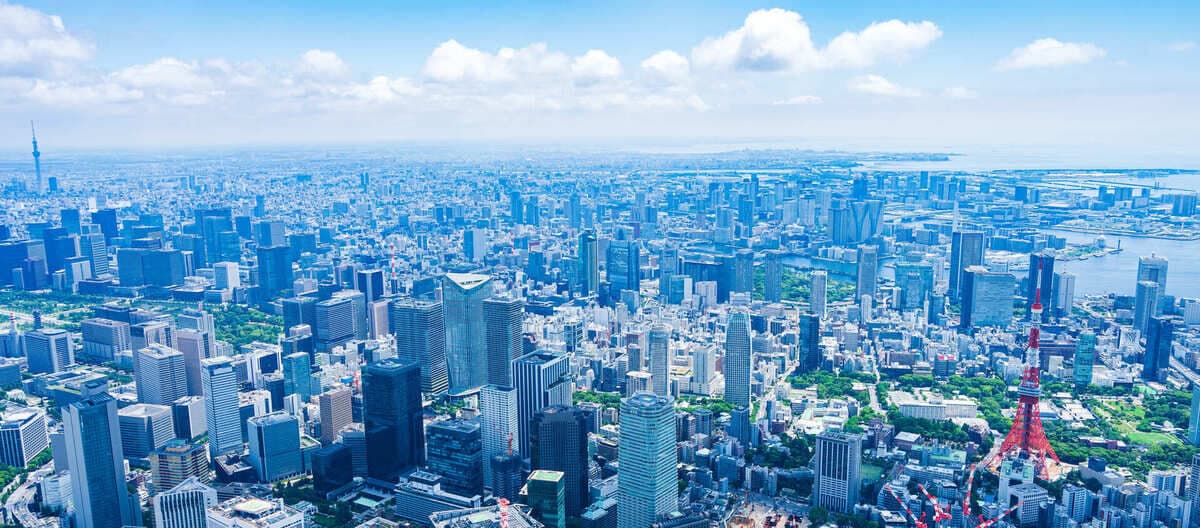
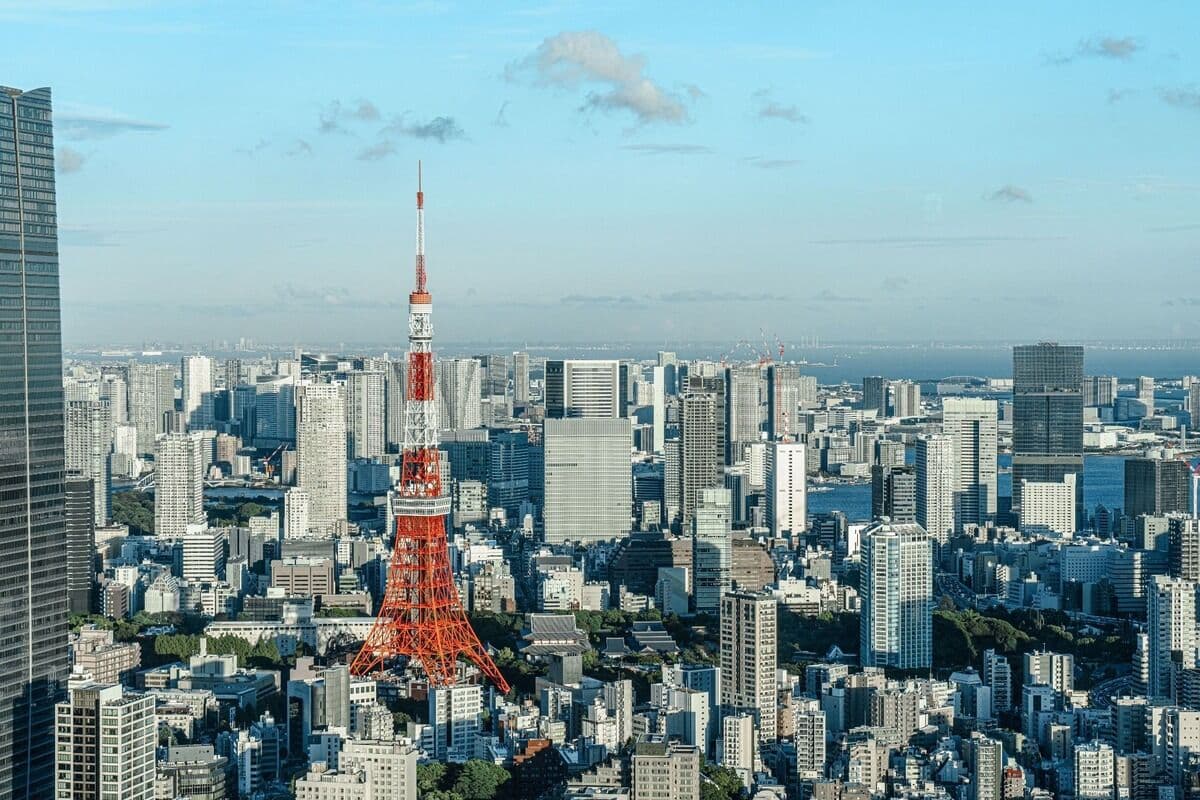
Many overseas buyers are surprised when they first research Tokyo property prices because Japan is often perceived internationally as an affordable country. In reality, central Tokyo has experienced one of Asia’s strongest residential price increases over the past decade.
In 2026, average new condominium prices in Tokyo’s 23 wards exceeded ¥100 million for the third consecutive year, supported by supply shortages and rising construction costs. Luxury developments in Minato, Chiyoda, and Shibuya now compete with prime global cities in terms of pricing.
Land Scarcity and Strong Domestic Demand
Tokyo’s geography and urban structure play a major role in price growth. Unlike sprawling cities in North America, central Tokyo has very limited redevelopment land remaining, especially near major stations and business districts.
At the same time, domestic demand remains extremely concentrated in areas with strong transportation access, modern infrastructure, and high employment density. Even though Japan’s national population is shrinking, Tokyo continues attracting young professionals and high-income households from across the country.
Growing Interest From Overseas Investors
The weak yen has significantly increased overseas interest in Japanese property since 2022. Compared with cities such as Singapore, Hong Kong, London, or New York, many international investors still view Tokyo as relatively affordable on a global luxury basis.
Foreign buyers have become increasingly active in luxury condominiums, tower developments, hospitality assets, and income-producing apartments. Regional cities such as Fukuoka are also attracting overseas attention due to lower entry prices and long-term growth potential.
How Japanese Real Estate Prices Have Changed Since 2007
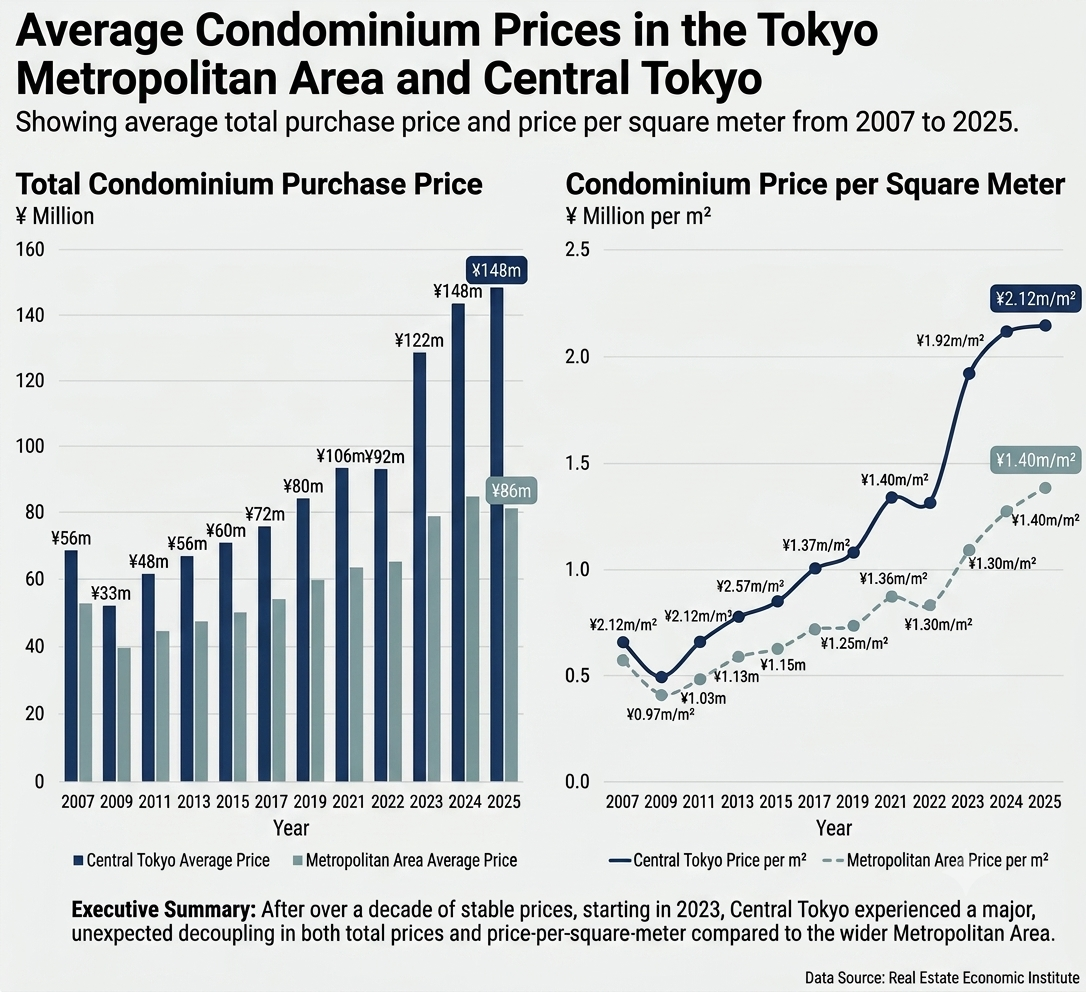
The graph above shows how condominium prices in both Central Tokyo and the Greater Tokyo metropolitan area have changed since 2007. While prices remained relatively stable during the late 2000s, the market began recovering after 2013 following Japan’s ultra-low interest rate policies and large-scale urban redevelopment projects.
Since 2021, condominium prices in Central Tokyo have risen sharply, significantly outperforming the broader Tokyo metropolitan market. Rising construction costs, limited land supply, strong domestic demand, and increased interest from overseas investors have all contributed to the surge in prices.
By 2025, the average condominium price in Central Tokyo exceeded ¥150 million, highlighting how Tokyo has become one of Asia’s most expensive residential markets. Despite Japan’s declining population overall, demand for well-located properties in central Tokyo continues to remain extremely strong.
source: Nippon.com
- Access curated off-market properties in Tokyo and prime resort areas
- Receive exclusive investment insights and market updates
- Connect with experienced cross-border real estate advisors
Tokyo House Prices by Ward
Property prices inside Tokyo vary enormously depending on the ward. In some central locations, prices can exceed ¥3 million per square meter. Meanwhile, outer residential wards remain comparatively affordable for families and first-time buyers.
Most Expensive Wards in Tokyo
1. Minato
Minato Ward remains Tokyo’s premier luxury residential district due to its concentration of embassies, international schools, and high-end commercial developments. Areas such as Azabu, Roppongi, and Aoyama attract executives, foreign professionals, and ultra-high-net-worth buyers.
Median Condo Transaction Price (2024): ¥160M–¥240M (70m² standardized)
Median Detached House Transaction Price (2024): ¥490 million
2.Chiyoda
Chiyoda Ward has extremely limited residential inventory because much of the ward consists of government buildings, office districts, and the Imperial Palace grounds. This limited supply contributes to some of the highest residential property prices in Japan.
Median Condo Transaction Price (2024): ¥160M–¥240M (70m² standardized)
Median Detached House Transaction Price (2024): ¥525 million
3.Shibuya
Shibuya has benefited enormously from large-scale redevelopment around Shibuya Station over the past decade. New luxury towers, office projects, and commercial facilities have transformed the ward into one of Tokyo’s strongest residential markets.
Median Condo Transaction Price (2024): ¥160M–¥240M (70m² standardized)
Median Detached House Transaction Price (2024): ¥290 million
4.Chuo
Chuo Ward, which includes Ginza and Nihonbashi, has become a major target for luxury condominium development and overseas investment activity. Waterfront tower projects in Tsukishima and Harumi have also contributed to rapid price growth.
Median Condo Transaction Price (2024): ¥66 million
Median Detached House Transaction Price (2024): ¥370 million
Sources:
More Affordable Areas in Tokyo
1.Adachi
Adachi Ward offers significantly lower housing prices while still maintaining relatively convenient rail access into central Tokyo. The ward remains popular among families and budget-conscious buyers seeking larger living spaces.
Median Condo Transaction Price (2024): ¥27 million
Median Detached House Transaction Price (2024): ¥46 million
2.Katsushika
Katsushika continues to provide some of the lowest condominium prices within Tokyo’s 23 wards due to its distance from major business districts and older housing stock.
Median Condo Transaction Price (2024): ¥26 million
Median Detached House Transaction Price (2024): ¥47 million
3.Edogawa
Edogawa Ward attracts buyers looking for larger homes at more reasonable prices compared with central Tokyo. Family-oriented neighborhoods and parks have supported stable long-term residential demand.
Median Condo Transaction Price (2024): ¥38 million
Median Detached House Transaction Price (2024): ¥50 million
4.Nerima
Nerima combines suburban-style living with relatively convenient train access to central Tokyo. Buyers can often purchase significantly larger homes compared with similarly priced properties in central wards.
Median Condo Transaction Price (2024): ¥30 million
Median Detached House Transaction Price (2024): ¥65 million
Sources:
House Prices in Rural Japan
Outside major metropolitan areas, Japan’s housing market looks completely different. In many regional towns and smaller cities, property prices remain extremely low due to population decline, aging communities, and weak long-term demand.
Popular Areas Outside Tokyo for Property Buyers
1.Osaka
Although Osaka is Japan’s second-largest metropolitan area, suburban and outer-city neighborhoods remain far more affordable than central Tokyo while still offering strong transportation infrastructure.
Average Condo Transaction Price (2024) : ¥40.78M
Average Detached House Transaction Price (2024): ¥23.59M
2.Kyoto
Kyoto attracts lifestyle buyers, retirees, and hospitality investors interested in traditional Japanese homes and tourism-related opportunities. However, supply in historic central districts remains limited.
Average Condo Transaction Price (2023): ¥31.24M
Average Detached House Transaction Price (2024): ¥23.59M
3.Fukuoka
Fukuoka has become one of Japan’s fastest-growing regional cities due to startup investment, population growth, and relatively affordable property prices.
4.Sapporo
Sapporo continues attracting buyers because relatively large modern homes remain affordable compared with Tokyo and Osaka. The city has also benefited from inbound tourism growth.
Sources:
-
MLIT FY2024 Trends Concerning Land (PDF) — Ministry of Land, Infrastructure, Transport and Tourism. Kinki region used condo and detached house averages (2024 annual). Figures compiled from REINS Kinki transaction data.
-
Kinki REINS Annual Market Data (PDF) — 公益社団法人近畿圏不動産流通機構 (MLIT-designated). City-level used condo average transaction prices for Osaka City and Kyoto City (2021–2023 annual).
-
REINS East Japan 2024 Annual Market Report (PDF) — 公益財団法人東日本不動産流通機構 (MLIT-designated). Tokyo metropolitan area aggregate benchmarks.
-
REINFOLIB Transaction Price Search — MLIT. Individual transaction queries available for all cities including Fukuoka and Sapporo; no pre-aggregated annual averages published.
Why Rural Houses in Japan Are Much Cheaper & What Buyers Should Consider
One of the most unique characteristics of Japan’s real estate market is the enormous price gap between major cities and rural areas. While condominium prices in central Tokyo can exceed ¥150 million, houses in some rural regions can still be purchased for under ¥10 million, and in certain cases, even for free through local “akiya” vacant home programs.
The biggest reason rural homes are much cheaper is Japan’s declining and aging population. Many smaller towns continue losing residents as younger generations move to Tokyo, Osaka, and other major cities for work and education opportunities. As population declines, housing demand weakens, causing property prices to stagnate or fall in many regional areas.
Another major factor is the growing number of vacant homes, known as “akiya.” According to government data, Japan has millions of vacant properties nationwide, particularly in rural communities. In some areas, the supply of older homes greatly exceeds buyer demand, putting additional downward pressure on prices.
However, buyers should also understand the challenges of purchasing property in rural Japan. Public transportation can be limited, making car ownership almost essential outside major cities. Reselling rural properties can also be difficult due to lower market liquidity and shrinking populations. In addition, many older houses require significant renovation and ongoing maintenance, especially traditional wooden homes built before modern earthquake standards.
What Affects House Prices in Japan?
Location and Train Accessibility
In Japan, transportation access is one of the most important factors influencing property values. Homes near major train stations and high-demand rail lines generally command substantial price premiums. Walking distance to stations is especially important in Tokyo because many residents rely heavily on public transportation rather than private vehicles. Even a difference of five minutes in walking time can significantly affect property values.
Government Data: Distance vs. Land Price Growth
Japan's Ministry of Land, Infrastructure, Transport and Tourism (MLIT) publishes annual land price surveys tracking how station distance affects property value changes. The data is clear: the closer to a station, the stronger the price appreciation.
In the three major metropolitan areas (Tokyo, Osaka, Nagoya), land prices changed as follows based on distance from the nearest station:
|
Distance from Station |
Annual Land Price Change |
|
Under 500m (~6 min walk) |
+1.7% |
|
500m–1km (~6–12 min walk) |
+1.3% |
|
1–1.5km (~12–18 min walk) |
+0.6% |
|
1.5–2km (~18–25 min walk) |
+0.1% |
|
2–3km |
−0.1% |
|
3–5km |
−0.4% |
|
Over 5km |
−1.1% |
Sources:
Building Age and Earthquake Standards
Japanese buyers pay close attention to building age because earthquake regulations changed significantly after the 1981 revision of Japan’s seismic standards. Properties built after 1981 are generally viewed as safer and more financeable. Newer buildings also tend to offer better insulation, disaster resistance, and energy efficiency, which helps support higher prices in urban markets.
Foreign Investment and Tourism Recovery
Foreign investment has become increasingly important in Tokyo’s luxury residential market, resort destinations, and hospitality assets. The return of international tourism has also strengthened demand in Kyoto, Osaka, and Okinawa. Low interest rates and the weak yen continue making Japanese property attractive for overseas buyers seeking stable developed-market assets.
Tourism as a Price Driver: Past Examples
Japan's tourism recovery has had a direct and measurable impact on land prices in high-visitor areas. According to MLIT's annual land price surveys (地価公示), the correlation is particularly visible in resort and cultural tourism destinations.
Niseko, Hokkaido is the clearest case. As Japan's most internationally recognized ski resort and a magnet for Australian, Singaporean, and Hong Kong buyers, land prices in the Hirafu resort core reached ¥189,000/sqm, a +21.9% year-on-year increase, driven by tourism demand and foreign development activity. The surrounding Kutchan town averaged ¥120,750/sqm at +12.3%.
Okinawa shows the same pattern in resort zones. MLIT data records land price growth of +8.8% in Onna village (a major resort corridor along the west coast) and +23.1% in Miyakojima's Ueno district, both driven by hotel and vacation rental investment tied directly to inbound tourism growth.
Osaka saw its Minami district (Namba/Shinsaibashi) overtake Kita (Umeda) in commercial land growth for the first time in six years, fueled by inbound tourism and the upcoming Expo, with Osaka City residential land rising +5.8%.
These examples share a common thread: in each case, rising foreign visitor numbers preceded and sustained the price increases. Japan welcomed 36.87 million foreign visitors in 2024 (JNTO), surpassing the pre-COVID peak of 31.88 million in 2019, and land prices in tourism-intensive areas outperformed the national average by a significant margin.
Sources:
Japan Real Estate Outlook for 2026 and Beyond
Will Tokyo Property Prices Continue Rising?
Tokyo property prices are expected to remain strong in 2026 and beyond, particularly in central wards such as Minato, Shibuya, and Chuo. One major reason is the continued shortage of new housing supply in central Tokyo, where land availability remains extremely limited. At the same time, construction costs and labor shortages continue pushing development costs higher.
Large-scale redevelopment projects are also helping support long-term price growth. Major projects around areas such as Toranomon, Shibuya, Yaesu, and Shinagawa continue attracting both businesses and wealthy residents, increasing demand for high-end residential properties.
What the Data Shows
According to MLIT's 2026 Land Price Survey, land prices rose 2.8% nationwide, the strongest increase since 1992. Tokyo's five central wards averaged +13.0% in residential land, led by Chuo (+13.9%), Minato (+12.7%), and Meguro (+12.5%). The average new condo in Tokyo's 23 wards reached ¥137.84 million in fiscal 2025, up 18.5% year-on-year. Forecasters project a further 3–6% price growth over the next 12 months, with central areas expected to outperform.
Redevelopment Zones Leading the Way
Redevelopment is a key price catalyst. Shibuya Sakuragaoka rose 29% tied to the Shibuya Station Redevelopment project. Takanawa Gateway City (Shinagawa), which opened in spring 2026, is already lifting surrounding residential demand. These projects reflect structural neighborhood changes that sustain prices over the long term, not short-term spikes.
Sources:
Conclusion
Japan Has Both Extremely Cheap and Extremely Expensive Real Estate
Japan’s real estate market is highly diverse. In central Tokyo, luxury condominiums can easily exceed ¥100 million to ¥200 million, while some rural homes in regional areas may cost less than a new car. This wide pricing gap is one of the most unique aspects of the Japanese housing market.
Tokyo Property Prices Are Much Higher Than Many Foreign Buyers Expect
Many overseas buyers assume Japanese real estate is cheap because of Japan’s low interest rates and weak yen. However, central Tokyo has become one of Asia’s most expensive residential markets due to limited land supply, redevelopment projects, and strong demand from both domestic and international buyers.
Understanding Regional Differences Is Key to Making the Right Purchase
The Japanese property market varies dramatically depending on location. Tokyo and Osaka continue seeing strong demand and rising prices, while many rural regions face declining populations and weaker resale markets. Buyers should carefully consider lifestyle, transportation access, long-term investment potential, and maintenance costs before purchasing property in Japan.
FAQ
Can foreigners buy property in Japan?
Yes. Japan places very few restrictions on foreign property ownership, and foreigners can buy real estate in Japan without permanent residency or citizenship.
Is Tokyo real estate still a good investment in 2026?
Many investors still view central Tokyo real estate as attractive due to limited supply, strong rental demand, and ongoing redevelopment projects. However, prices have risen significantly in recent years, especially in luxury condominium markets.
Why are houses in rural Japan so cheap?
Rural properties are often cheaper because of population decline, aging communities, lower housing demand, and the large number of vacant homes known as “akiya.”
Are old houses in Japan worth buying?
Older homes can offer excellent value, but buyers should carefully check earthquake resistance standards, renovation costs, and long-term maintenance requirements before purchasing.
Which areas in Japan have the strongest real estate growth potential?
Tokyo remains the strongest market overall, but Osaka, Fukuoka, Sapporo, and Okinawa are also attracting increasing attention due to tourism growth, redevelopment projects, and relatively lower entry prices.
source:
- Access curated off-market properties in Tokyo and prime resort areas
- Receive exclusive investment insights and market updates
- Connect with experienced cross-border real estate advisors